[International Symposium] « Northern Lights III: Cultural Coexistence and the Future of Japanese Society », Strasbourg, 14-16 March 2025

NORTHERN LIGHTS III: CULTURAL COEXISTENCE AND THE FUTURE OF JAPANESE SOCIETY

A Comparative Perspective from North to South
多文化共生と今後の日本社会-北と南の比較から考える

14 – 16 March 2025

https://drive.google.com/file/d/19-DykvG3XftbC1tTQGOrr1pCDtW3xs63/view

March 14, 2025 – Council of Europe, Strasbourg

10:00–12:00 (CET) – Opening Lectures

  • TANIMOTO Akihisa 
    Visiting Researcher, HIJAS; Professor, Hokkaidō University (Graduate School, Faculty of Humanities and Human Sciences)
    « Cultural Coexistence and the Future of Japanese Society: A Comparative Perspective from North to South« 
    「多文化共生と今後の日本社会︓北と南の比較から考える」
  • François LACHAUD 
    Professor of Japanese Studies, École française d’Extrême-Orient / French School of Asian Studies
    « Beyond Mingei: Yanagi Muneyoshi, Ainu Culture, Northern Worlds« 
    「民藝の彼方—柳宗悦、アイヌ文化、そして北方世界」

For contact and registration for the opening conference and/or online participation, please email: ceeja@ceeja-japon.com

Centre Européen d’Etudes Japonaises d’Alsace
1, rue Camille Schlumberger 68000 Colmar
ceeja@ceeja-japon.com

Programme

[Journée d’étude] « Les mobilités en Asie au prisme des sources des Missions étrangères de Paris (XIXe-XXIe siècles) », 24 mars 2025, Paris

Le lundi 24 mars 2025, l’EFEO et l’IRFA — l’institut en charge de préserver, d’enrichir et de valoriser le fonds documentaire des Missions étrangères de Paris — organisent une journée d’étude au siège des MEP intitulée : « Les mobilités en Asie au prisme des sources des Missions étrangères de Paris (XIXe -XXIe siècles) ». Les conférences porteront sur plusieurs pays d’Asie : Corée, Chine, Japon, Tibet, Cambodge et Laos.

Pour plus de détails, vous pouvez consulter la page de l’IRFA dédiée à la journée sur ce lien.

[Workshop IFRJ] « Développement et patrimoine urbain, regards croisés sur les villes japonaises et coréennes », 26 & 27 février 2025, Séoul

Nous vous annonçons la tenue de l’événement scientifique suivant: Workshop IFRJ Hors les murs à Séoul, les 26 et 27 février 2025, sur le thème « Développement et patrimoine urbain, regards croisés sur les villes japonaises et coréennes ». Programme détaillé sur ce lien.

Il est préférable de s’inscrire, auprès des contacts suivants:

– Table ronde du 26 février à l’Université Hongik « Villes coréennes et japonaises entre rénovation et reconstruction »

Inscription: contactclubdereflexion@gmail.com

– Conférence de Raphaël Languillon du 27 février à Seoul National University Asia Centre « Rescaling Tokyo in a shrinking country »

Inscription: mnjsk@snu.ac.kr

LIEN vers affiche dédiée: https://snuac.snu.ac.kr/eng/index.php/2025/02/03/rescaling-tokyo-in-a-shrinking-country/

– Conférence de Delphine Vomscheid du 27 au Centre EFEO de Séoul, Korea University « Rebuilding Japan’s feudal castles: an architectural and social history »

Inscription: elisabeth.chabanol@efeo.net

LIEN vers page dédiée: https://www.efeo.fr/blogs_post.php?bid=17&nid=4701

[Journée d’études] 4èmes Rencontres de l’association interdisciplinaire des ethnographies japonaises, 7 mars 2025, Paris

Terrains japonais
Journée d’étude organisée à l’Inalco, salle de Silvestre de Sacy, Maison de la Recherche, 2 rue de Lille, 75007 Paris. Lien vers le Carnet de l’Association interdisciplinaire des ethnographies japonaises.

Programme

9:00 Accueil

09:30 Aurélien ALLARD (Université de Lille/Université de Bruxelles)
• Introduction à la journée d’étude

09:45 Yoko IWASHITA (Université de Lille)
• Entretiens biographiques : Comment co-construire un objet de
  recherche entre chercheur et interviewé(es) dans le processus
  de recherche qualitative ?

10:20 Hugo TREVISAN (EHESS)
• Ethnographier des groupes religieux minoritaires au Japon :
  enjeux méthodologiques d’un terrain contemporain

10:55 Marie MONTENAIR (Université de Liège)
• Un terrain auprès de jeunes belgo-japonais en Belgique : défis
  méthodologiques et accès à l’intimité

11:30 Amaël COGNACQ (Université de Tokyo)
• Ethnographie comparative des communautés anti-féministes japonaises
  et françaises en ligne : Discussions méthodologiques

12:00  Fin de la session du matin

Après-midi 

13:30 Inès AUFRAY (EHESS)
• Les formes de féminismes au Japon

14:05 Miyako HAYAKAWA (ULB)
• Tendances récentes de l’émigration japonaise en Europe

14:40   Jean-Christophe HELARY (CRESCO)
• Mon terrain en 30 heures, et le logiciel libre.

15:15   Alice DOUBLIER (CNRS)
• Tomber dans le moût. Sur quelques mésaventures d’une ethnographie
  avec des fabricants de sauce soja.

15:50   Fabio GYGI (SOAS)
• Oshikatsu : a new paradigm for commodified intimacy?

16:25 Échanges

16:50 FIN

17:30 Projection d’un film à Auditorium Dumézil

Film documentaire Tokyo Kurds 東京クルド de HYŪGA Fumiari 日向史有, VOJSTF, 2021, 103 min.

Avec la collaboration du festival Fenêtres sur le Japon.

Il sera possible d’assister à la journée d’étude en ligne en utilisant le 
lien suivant :
https://univ-lille-fr.zoom.us/j/92524351437?pwd=uLLamNlfkgx1zAnhdPC5lQFuerRGpT.1

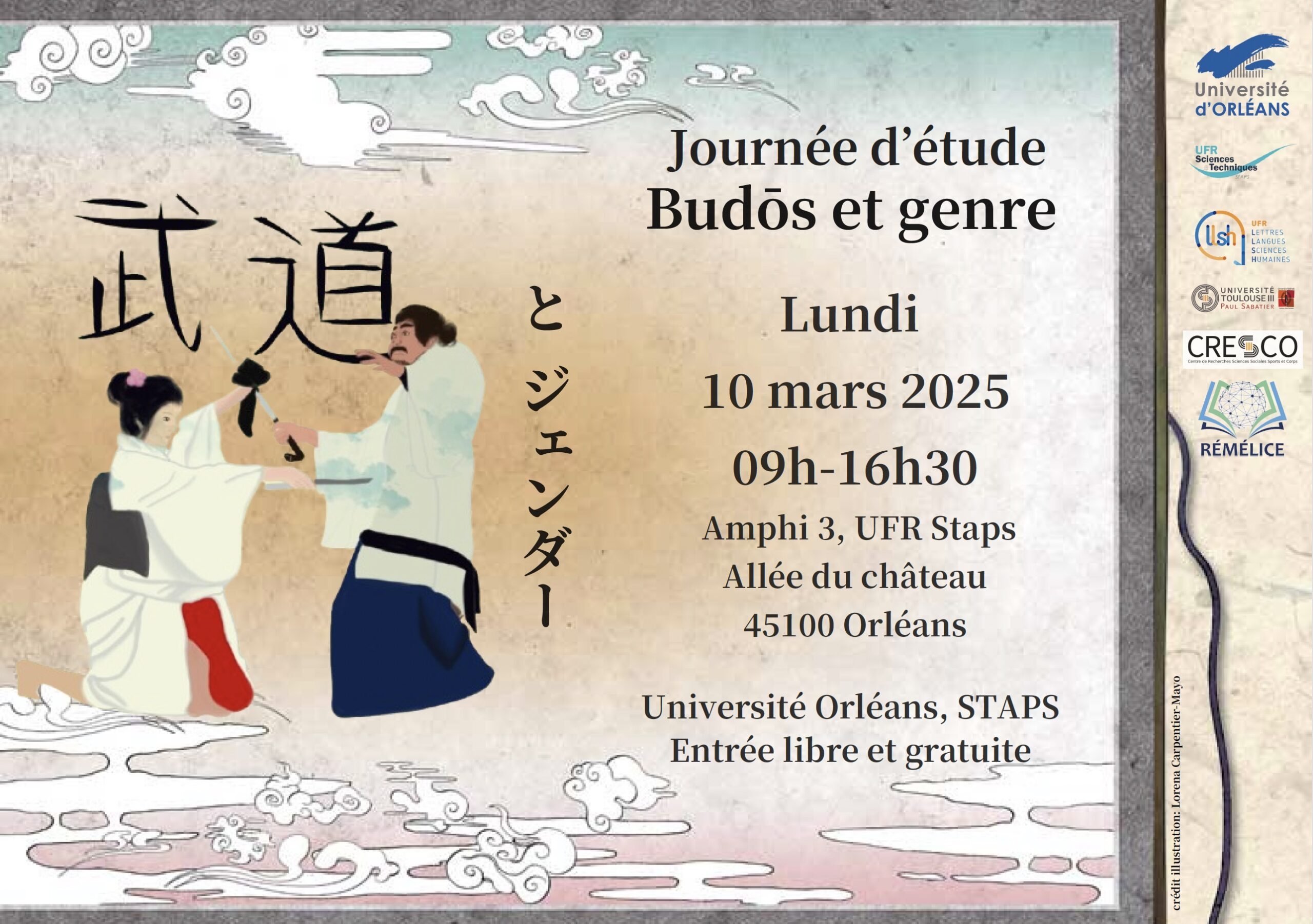
[Journée d’étude] « Budôs et genre », Université d’Orléans, 10 mars 2025

Vous trouverez le programme (sur ce lien) et le poster de la journée d’étude « Budôs et genre » organisée le 10 mars 2025 à l’université d’Orléans.

  • 9 h Accueil
  • 9 h 30 Yves CADOT
    Introduction à la journée d’étude
  • 10 h 10 Elise AWAÏDA CARTON & Karine PARET
    Deux carrières dans le judo : dialogue de femmes
  • 10 h 50 Stéphane CARPENTIER
    Le rapport au corps et au genre dans les budōs
  • 11 h 20 Chloé BELLEC
    Le naginata, un art martial au féminin
  • 11 h 50 Fin de la session du matin
  • 12 h Déjeuner au CROUS
  • 13 h 40 Paul BÉNÉZET
    « You Hit Like a Woman! ». Perspectives croisées sur la masculinité et ses 
    soi-disant attributs dans le monde des koryū.
  • 14 h 10 Gabrielle LAUMONIER
    Une histoire du vêtement sportif au Japon et de la création du « genre » à 
    travers le vêtement au cours du 20e siècle
  • 14 h 40 Pause
  • 14 h 55 Jean-Christophe HELARY
    Le kendō au Japon : chute de la natalité, désintérêt pour la pratique, et 
    regards genrés de l’institution
  • 15 h 25 Critical Embodied Women’s Martial Art (CEWMA)
    The Limits of Women Empowerment in Budō
  • 16 h 00 Échanges
  • 16 h 30 Clôture

[Journée d’étude] « The Speech Bubble, Between Text and Image », 14 mars 2025, Collège de France

The Speech Bubble, Between Text and Image
International one-day symposium
Friday, March 14th, 2025 

Location: Room Jacques Glowinski, Collège de France, 11 place Marcelin-Berthelot, 75231 Paris cedex 05

Event held in person with a virtual attendance option (Zoom link provided upon request). With the support of the Maison de la Culture du Japon à Paris and the East Asian Civilizations Research Centre (CRCAO)

Contact: information and Zoom link: marianne.simon-oikawa@u-paris.fr

Presentation
This one-day symposium aims at showing the full complexity of the speech bubble, an object that has been largely neglected by research until now, and that cannot be defined solely as ‘the curve surrounding the words spoken by comic strip characters’ (Trésor de la langue française). Based on the observation that the speech bubble often also contains images and even blank spaces, and that its forms and functions vary according to the objects, periods and geographical areas in which it is present, the papers presented during this symposium propose to analyse the complex relation between speech bubble, text and image in a number of visual sources objects drawn from Japanese corpora or indirectly linked to Japan.This one-day symposium is the first event organized within the ‘Histoires de bulles’ programme (CRCAO, East Asian Civilizations Research Centre, 2025-2029), which aims to study the speech bubble and turn it into an object of knowledge, both in terms of its own characteristics and its visual and wider cultural ecosystem, in order to ultimately identify an “economy of the bubble”, or even sketch out a general theory of it.

Website: https://www.crcao.fr/recherche/formes-du-texte-usages-de-limage-dans-les-livres-japonais/?lang=en

Program

Morning session

Chair: Matthias Hayek (École Pratique des Hautes Études-PSL, to be confirmed)

09:30-09:45. Opening remarks. Marianne Simon-Oikawa (Paris Cité University)

09:45-10:30. Marianne Simon-Oikawa. Fukidashi, Building an Object Between Text and Image
In Japanese, the word fukidashi, which designates the speech bubble, does not refer to any specific form or content. It instead designates a breath exhaled out of an unidentified source. The variety of objects in which the speech bubble appears in Japan during the Edo period makes it necessary to draft a list of the types of objects in which it is concentrated, and to make a few initial hypotheses about it, which future research may support, develop or contradict. This presentation will focus on selected examples that challenge the definition of the bubble as a container for speech. 

10:30-11:15. Estelle Bauer (Musée Guimet). When Pictures Start Talking. Dialogues and other Texts Written in Emaki (gachûshi画中詞)
If speech bubbles are a way to make characters talk, some emaki achieve the same effect by writing dialogue directly next to them. We will look at a few examples to reflect on the role these gachûshi play in the production of the visual narrative: they provide details about the characters’ actions and emotions; they introduce a sense of time into the picture. 

11:15-12:00. Jaqueline Berndt (Stockholm University). Speech Balloons Beyond Speech: The ‘Return’ of Pictorial Contents?
Manga researchers have approached fukidashi mainly as speech balloons – “transdiegetic devices” that turned manga into “audiovisual comics” (Exner 2022) and visual modifiers of dialogue lines’ auditory properties (Manga no yomikata 1995). Attention has also been paid to speech balloons’ placement on manga pages and their role in visually guiding the reader’s gaze, while the analysis of their contents has considered hand-writing and type, font variations, and punctuation marks. Inspired by pictorial dream balloons from the late Edo period, my presentation focuses on non-linguistic contents: small pictures of characters’ heads inside the balloon, as well as pictorial runes such as sweatdrops and cross-popping veins attached to a balloon rather than the respective speaker. These devices internalize the external parts of Hosoma’s “speaker–listener–object” triangle (2023), ultimately foregrounding relationalities through a blurring of previously clear divides. In addition, pictorial balloon contents serve exaggeration (both humorous and affective) and instruction (efficiently providing information), as well as an economy of space. This sets them apart from Edo-period imagery, which nevertheless may help challenge simplistic assumptions of ‘speech’ balloons as providing an auditory experience.

Afternoon session

Chair: Thomas Lamarre (The University of Chicago)

14:00-14:45. Blanche Delaborde (Fukuoka University). The Spatial Paradox of Speech Bubbles in Manga
Speech bubbles in manga form a surprisingly complex narrative device. In particular, although the space delimited by the outline of the bubbles initially appears as a two-dimensional space analogous to that of the page, many examples contradict this idea. For instance, speech bubbles outlines are often porous, especially in the presence of handwritten secondary lines. In other cases, the bubbles carry iconic or conventional signs (keiyu) that suggest some depth. In addition, the anchoring of the balloons to the three-dimensional diegetic space presents many ambiguous cases, that blur between two-dimensional and three-dimensional spaces. 

14:45-15:30. Ladan Niayesh. From Playscript to Mangascript: The Speech Bubbles in Manga Shakespeare’s The Tempest
As the spearhead of the ‘Self Made Hero’ company’s endeavour to break through a heavily Asianised global manga market, the British ‘Manga Shakespeare’ series paradoxically enlists that icon of European culture not hegemonically, but as a mediator gesturing East. Speech bubbles occupy a key position in this process of cultural negotiation in one of the early volumes in the series, The Tempest (2007), illustrated by a British mangaka but set in a post-industrial, environmentally damaged island beaten by Hokusai-style waves. The speech bubbles keep about forty percent of the original Shakespearean text, but adapt it to visually and culturally navigate between a theatrical script and the aesthetic alphabet of the manga. This involves for example playing on bubble contours to express emotions and speech volume in the opening tempest scene, sticking in that to the received conventions of Japanese manga. But the artist also instills less common and inventive features into the manga format, such as deleting the speech bubble altogether to blend thought and nature for monologues. Eventually tailored into strips of paper carrying identity, speech is what both the spirit Ariel and the magician Prospero dissolve into in the final pages of the volume, recalling a dilapidated folio of Shakespeare’s complete works scattered and lost to the winds, or alternatively and more optimistically Prospero’s magic book travelling east over the oceans for a fresh lease of life with a rejuvenated audience.

[Colloque] « L’énigme Tōgo Murano – un cas singulier dans l’architecture du XXe siècle », MCJP, 11 février 2025 à 18h30

Colloque « L’énigme Tōgo Murano – un cas singulier dans l’architecture du XXe siècle »

L’énigme Tôgo Murano – Maison de la culture du Japon à Paris

Date : Mardi 11 février 2025 à 18h30

Lieu : Grande Salle (niveau -3) de la Maison de la culture du Japon à Paris (101 bis, quai Jacques Chirac 75015 Paris)

En japonais et en français avec traduction consécutive 

Entrée libre sur réservation Choix des places [Maison de la culture du Japon à Paris | 11.02.2025 – 18:30 | L’énigme Tôgo Murano] – Maison de la culture du Japon à Paris

Avec plus de 300 bâtiments construits, Tôgo Murano fut l’architecte le plus prolifique du XXe siècle au Japon. Il est aussi l’un des moins connu. 

Avec l’aide de l’éminent architecte Kengo Kuma, de Kazuto Kasahara, dépositaire de l’archive Murano au Kyoto Institute of Technology, et en présence des petites-filles Atsuko et Tomoko Murano, ce colloque apportera un éclairage inédit sur sa vie, sa carrière et son œuvre. 

Cet événement sera accompagné d’une présentation illustrée par les images récentes de Martin d’Orgeval.

Modérateur : 

Olivier Renaud-Clément, commissaire d’exposition et consultant artistique

Intervenants : 

Kengo Kuma, architecte

Kazuto Kasahara, maître de conférences à l’Université des arts et techniques de Kyoto, dépositaire de l’archive Tôgo Murano                            

Autres participants :

Atsuko Murano et Tomoko Murano Abalos, petites-filles de Tôgo Murano

Martin d’Orgeval, artiste et photographe

Vous pouvez également participer à distance sur YouTube.

Conférence « L’énigme Tôgo Murano – Un cas singulier de l’architecture du XXe siècle 村野藤吾の建築を巡って »

Retrouvez aussi nos conférences passées sur notre chaîne YouTube :

[Journée d’étude internationale] « Manga in Every Sense », 7 mars 2025, Paris

Manga in Every Sense
Journée d’étude internationale
Vendredi 7 mars 2025
Université Paris Cité, 5 rue Thomas Mann, 75013 Paris, salle 406A, bâtiment A

Un lien Zoom communiqué sur demande permettra de suivre la journée à distance (marianne.simon-oikawa@u-paris.fr)

Organisation : Marianne Simon-Oikawa – Dépliant et programme à télécharger sur ce lien.

Soutien : Maison de la Culture du Japon à Paris et Centre de recherche sur les civilisations de l’Asie orientale

Program

Morning session

Chair: Clara-Akiko Wartelle-Sakamoto (Paris Cité University)

09:30-09:45. Opening remarks. Marianne Simon-Oikawa (Paris Cité University)

09:45-10:30. Blanche Delaborde (Fukuoka University). Two Senses to Recreate Them All: Onomatopoeia in Manga

Onomatopoeia in manga goes far beyond the rendering of simple sounds, and may be used to express all types of sensations: sight, hearing, smell, and touch, but also sensations related to movement, pain, temperature or even supernatural phenomena, as well as a wide range of emotions. Highly inventive, onomatopoeia in manga appeals to the senses of sight and hearing to develop and combine different senses, in order to create an immersive experience for the reader.

10:30-11:15. Irène Leroy Ladurie (Lausanne University). From Guido Crepax to Kazuo Kamimura, from Fumetti to Gekiga. Five Senses on Display in Everyday Life Narratives

Kazuo Kamimura found in Guido Crepax and some of his works published and translated in Japan, notably Valentina in the early 1970s, a source of inspiration for his own work. Indeed, the two authors share a similarity in the representation and narration of intimate sensationS and sensuality in everyday life. Based on the study of cultural and aesthetic transfers, I explore the way in which the work of these two authors during the 1970s graphically trancribes the internal sensations of the characters that could remain unseen, thereby reinventing the experience of drawn narratives.

11:15-12:00. Jaqueline Berndt (Stockholm University). Manga Smells: Visual Medium and Olfactory Sensations

Manga studies has increasingly addressed not only sight but also sound (Delaborde, Exner) and, closely related to the medium’s materialities, touch (Hosoma, Yamamori, Kálovics). But the ‘lower senses’ (i.e., the gustatory and olfactory) do not necessarily come to the fore. This contribution focuses on smell, how it is performed non-verbally, and how its historical significance changes. I will discuss the shift in representation from 1970s corporeality (ex., Kamimura Kazuo, Torii Kazuyoshi) to the ‘primacy of the visual’ that began to prevail in the mid-1980s (ex., Sugiura Hinako), consider the ‘odorlessness’ of shōjo manga, and ponder how smell, a highly contingent sense that escapes control, fits in manga’s aesthetic standardization, which forms a prerequisite for participation.

Afternoon session

Chair: Blanche Delaborde (Fukuoka University)

14:00-14:45. Thomas Lamarre (The University of Chicago). Weighty Matters: A Reading of Proprioception in Manga

This paper explores the phenomenon of weightlessness in manga.  Because comics combine image and text, a good deal of analysis has focused on the wealth of visual, verbal, and acoustic forms, ranging from the arts of line and perspective to modes of speech and sound effects.  Less attention has been paid to proprioception and kinesthesia — to the sense of position, movement, force, effort, and heaviness.  Yet unlike the photographic arts, which more readily capture a feeling for mass and weight and thus position, force, and effect, comics adopt various conventions to convey these sensations.  Proception and kinesthesia are arguably of particular importance in manga due to the tendency (prominent in commercial manga publications) introduce multiple lines of movement across page layouts, which amplifies the overall sensation of a weightless floating and drifting, sometimes even the midst of intense action.  This weightlessness affects the experience of duration as well, for it breaks with measurable movement, calculable time and action-reaction sequences.  To arrive at a better understanding of proprioception and kinesthesia, this paper proposes not only an overview of the phenomenon in manga but also a careful examination of the works of Matsumoto Taiyō, with an emphasis on Ping Pong (Pin Pon 1996-97) where weightlessness intervenes in the linear sequencing of ping-pong tournaments to offer a meditation on the nature of temporality. 

14:45-15:30. Xavier Guilbert (chief editor of collectif du9). Silent yet Vibrant – The Ephemeral Urban Poetry of Adachi Mitsuru

This contribution intends to explore the sensory landscapes crafted by Adachi Mitsuru (born in 1951) in the chapters’ introductory pages of his manga. Through the deliberate absence of text (and sometimes even characters), these short sequences often constitute suspended moments in the narrative. While sports manga usually revolves around over-the-top action, these little quiet bubbles provide the reader with an almost contemplative, and at times poetic, experience.

15:30-16:15. Julien Bouvard (Jean Moulin Lyon 3 University). The Tactile Dimension of Reading Manga – From Print to Screen

Reading manga is not limited to a visual or narrative experience; it also involves the sense of touch, an aspect often overlooked in academic studies of this medium. This presentation explores how the materiality of manga – their format, paper, weight, and even their handling – contributes to the reader’s sensory experience. It also offers an observation on the differences between reading experiences on paper and digital platforms.